
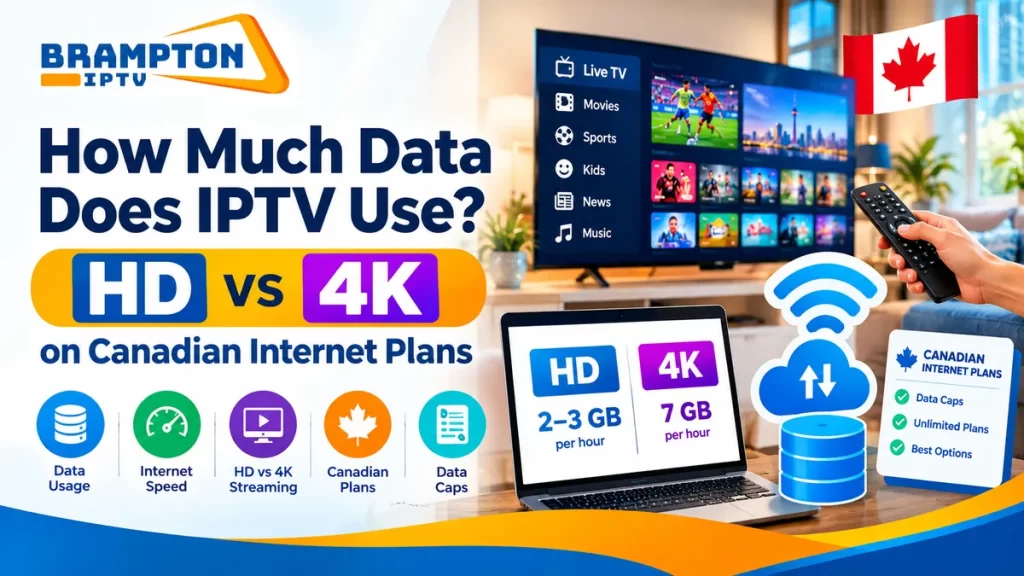
Most homes in Canada use TV via the Internet today and this data consumption goes unnoticed until the service provider issues a warning. The important point to consider here is the question of how much data does IPTV use? The answer depends on the image quality, the viewing time and how many screens use this at once.
Already Have an IPTV Box?
Get more from your IPTV box with a reliable service designed for smooth HD and 4K streaming, fast channel loading, and an easy viewing experience.
Start Your Free IPTV TrialTest the service before choosing a subscription
IPTV distributes videos using the internet through small compressed packets. What is important with a data allocation is the bitrate, which is the amount of data transmitted per second. A high bitrate video will appear clearer but uses more gigabytes.
Resolution affects consumption most. The data given below is an average and will vary based on individual providers, channels and codecs.
| Video Quality | Typical Bitrate | Data Per Hour | Data Per Month (4 Hours Daily) |
| Standard Definition (480p) | 2–3 Mbps | 1 GB | 120 GB |
| HD (720p) | 4–5 Mbps | 2 GB | 240 GB |
| Full HD (1080p) | 6–8 Mbps | 3 GB | 360 GB |
| 4K Ultra HD | 15–25 Mbps | 7 GB | 840 GB |
Full HD with 1080p is usually the standard that live channels broadcast with. It’s quite clear and doesn’t overload your domestic Internet connection too much. An average household that spends 4 hours a day watching TV consumes about 360 GB per month.
The 4K streaming comes in four times the number of pixels as the full HD and the costs of transferring the data are doubled. From the large screen perspective, the gap can be detected, just like the bill, for the amount of viewing of four hours exceeds 840 GB.
Canadian providers do not charge for their data in the same manner. Some packages have an unlimited data option, while others may have limits of a couple hundred to even one terabyte per month. Exceeding the data limit could lead to additional fees or reduced speeds.
Speed and data are two different measurements. Speed decides whether a stream plays without buffering. Data decides how long the monthly allowance lasts. Minimum speeds per stream are as follows.
A home running one 4K stream and two HD streams needs roughly 45 to 50 Mbps.
Multiply the gigabytes per hour by hours per day and again by thirty days and do it for all screens. Take two screens having HD resolution being used for three hours in a day using 3GB per hour. This results in a monthly consumption of 540 GB. If there is a fourth screen using 4K resolution with 7GB per hour for two hours per day, it will consume 420 GB.
Usage can be lowered without a visible drop in quality:
Anyone comparing IPTV subscription plans Canada offers should look at the streaming service and the internet package together. A provider with 4K channels adds little if the home plan has a low monthly cap.
When reviewing IPTV subscription plans Canada providers list, check supported resolutions, the number of allowed streams and codec efficiency. Then match the result with an internet plan that has enough speed and enough data. Heavy viewers are better off with an unlimited package.
Pair your IPTV box with a reliable IPTV service and enjoy premium channels, smooth HD and 4K streaming, stable performance, and dependable support.
Get Your IPTV SubscriptionChoose a plan that fits your viewing needs
The picture quality, viewing time and number of screens will determine the total charge for each month. HD is sufficient for the majority of homes, while 4K requires a lot more in terms of data and bandwidth. An individual aware of the amount of data used by IPTV will choose appropriate IPTV subscriptions in Canada.